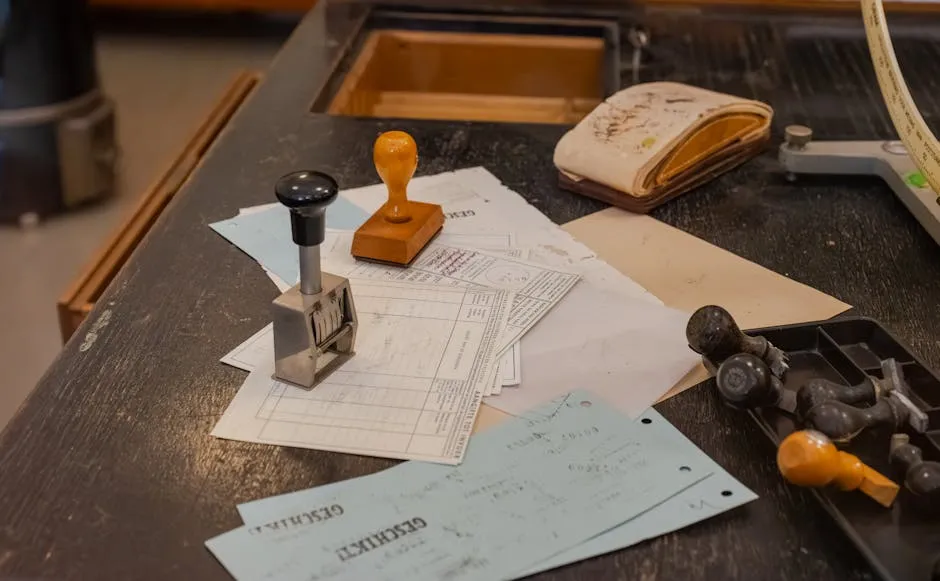
Whether you’re a new notary or just need a refresher, following the correct notarization process protects both you and the signer. This guide covers every step of a proper notarization.
Before You Begin
Make sure you have these items ready:
- Your notary stamp or seal
- Your notary journal (record book)
- A pen with blue or black ink
- The document to be notarized (unsigned unless you’re doing an acknowledgment)
Important: The signer must always be physically present during the notarization — in person, or over approved two-way audio-video if you are specifically commissioned for remote online notarization. This is non-negotiable and is the most critical rule of notarization.

Step 1: Verify the Signer’s Identity
The most important part of any notarization is confirming the signer is who they claim to be. Use at least one of these methods:
- Personal knowledge — you personally know the signer (some states limit or no longer allow this)
- Credible witnesses — one or two witnesses who personally know the signer (used when the signer lacks acceptable ID; the count depends on your state)
- Identification documents — the most common method
Acceptable identification typically includes:
- A current state-issued driver’s license or ID card
- A valid U.S. passport or passport card
- A military ID card
- Other government-issued photo ID with signature
In California, the ID must be current or issued within the last 5 years and contain a photo, signature, and physical description; other states set their own ID rules, so check yours.
Step 2: Review the Document
Before proceeding, scan the document briefly to check:
- The document is complete (no blank spaces in important fields like dollar amounts)
- There are no obvious signs of fraud
- The document type matches what the signer is asking you to notarize
- The document doesn’t contain blank spaces that could be filled in later
Step 3: Ensure the Signer Understands the Document
As a notary, you’re not responsible for explaining the document’s contents, but you should confirm the signer:
- Understands what they’re signing
- Is signing voluntarily (not under duress)
- Appears to be competent and aware
If the signer seems confused or coerced, do not proceed with the notarization.
Step 4: Have the Signer Sign the Document
The signing process depends on the type of notarization:
- Acknowledgment — the signer has already signed or will sign in your presence. You’re certifying they appeared before you and acknowledged signing.
- Jurat — the signer must sign the document in your physical presence after you administer an oath or affirmation.
Step 5: Complete the Notarial Certificate
The notarial certificate (the block of text at the end of the document) must include:
- The state and county where the notarization takes place
- The date of the notarization
- The signer’s name
- The type of notarial act performed
- Your notary signature
- Your stamp or seal
If the document doesn’t include a notarial certificate, ask the signer what type they need. Do not choose the certificate type yourself — that’s considered the unauthorized practice of law.

Step 6: Record the Notarization in Your Journal
Immediately after completing the notarization, record it in your notary journal:
- Date and time of the notarization
- Type of notarial act (acknowledgment, jurat, etc.)
- Signer’s name and signature
- Type of identification presented
- Document title or description
- Document date (if applicable)
- Fee charged (if any)
Step 7: Affix Your Notary Stamp
Place your stamp clearly and legibly:
- Near your signature on the notarial certificate
- Ensure the stamp is completely visible (don’t cover it with other text)
- The stamp must include your name, commission state, commission number, and expiration date
- Use stamp ink that copies clearly (black or blue)
Common Notarization Types
Here are the most common types you’ll encounter:
- Acknowledgment — The signer acknowledges they signed the document willingly. Most common type.
- Jurat — The signer swears or affirms the document’s contents are true. Used for affidavits and depositions.
- Oath or Affirmation — Administering a spoken oath (not always tied to a document).
- Copy Certification — Certifying that a copy of a document is a true and accurate reproduction.
- Signature witnessing — Witnessing a signature without any additional certification.
Common Mistakes to Avoid
- Notarizing without the signer present — the #1 mistake and grounds for revocation
- Failing to record in your journal — your journal is your best legal protection
- Using expired commission — check your expiration date before every notarization
- Letting someone else use your stamp — your stamp is for your use only
- Notarizing incomplete documents — never notarize a document with blank lines in critical fields
- Giving legal advice — you’re not a lawyer; if they have legal questions, refer them to an attorney
Frequently Asked Questions
Can I notarize a document for a family member?
Most states permit it, though many strongly discourage it, and a handful ban notarizing for certain close relatives. Financial institutions and title companies often reject documents notarized by a family member due to conflict of interest concerns.
What if the signer doesn’t speak English?
It depends on your state. Several states require you to communicate directly with the signer and do not allow an interpreter; others permit one if the interpreter is not a party to the transaction. Either way, you must verify the signer’s identity through acceptable identification documents.
How much can I charge for a notarization?
Fees vary by state. Most states set maximum fees — for example, California allows $15 per notarized signature, while Texas allows $10 for the first notarial act and $1 for each additional signature. Check your state’s specific fee schedule.
Do I need to keep my journal forever?
Most states do not require a journal at all, but where they do, retention rules vary. California, for example, requires you to surrender your journal to the county clerk (or retain it, depending on the circumstance) rather than discard it. Never throw away a journal without verifying your state’s retention rules.
What should I do if I make a mistake on a notarial certificate?
Do not use white-out. Instead, draw a single line through the mistake, write the correction nearby, and initial it. If the mistake is significant, attach a new notarial certificate with the correct information.